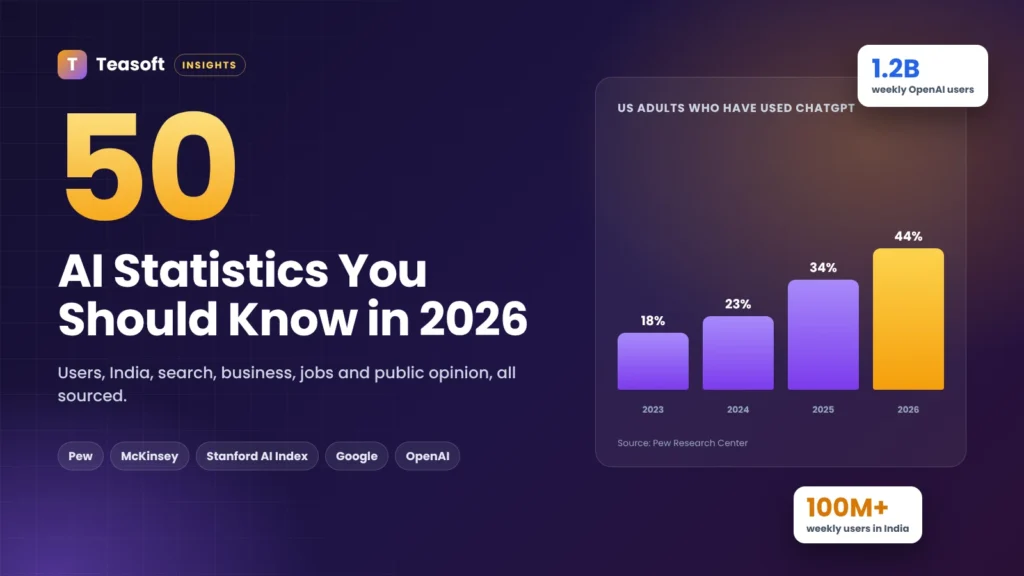
The most important AI statistics for 2026: ChatGPT and OpenAI products reach about 1.2 billion people a week, 49% of US adults use AI chatbots, and India has become ChatGPT’s largest market with 100 million+ weekly users. Google still handles 91% of search, but its AI Overviews reach 2.5 billion+ people a month. Nearly 9 in 10 companies use AI, yet only about 6% see big profit gains, and the WEF expects a net 78 million new jobs by 2030.
AI headlines are everywhere, but numbers are easier to trust than hype. We collected 50 of the most useful AI statistics from Pew Research Center, McKinsey, Stanford’s AI Index, Google, OpenAI and other primary sources, grouped by topic so you can find what you need fast.
Every statistic includes its source and date. Feel free to quote them, and please link back to this page. Last updated: November 2026.

Key AI Statistics at a Glance
| Statistic | What it means | Source |
|---|---|---|
| 1.2B | weekly users of ChatGPT and OpenAI products | OpenAI, Sept 2026 |
| 49% | of US adults use AI chatbots | Pew, 2026 |
| 100M+ | weekly ChatGPT users in India | OpenAI, Feb 2026 |
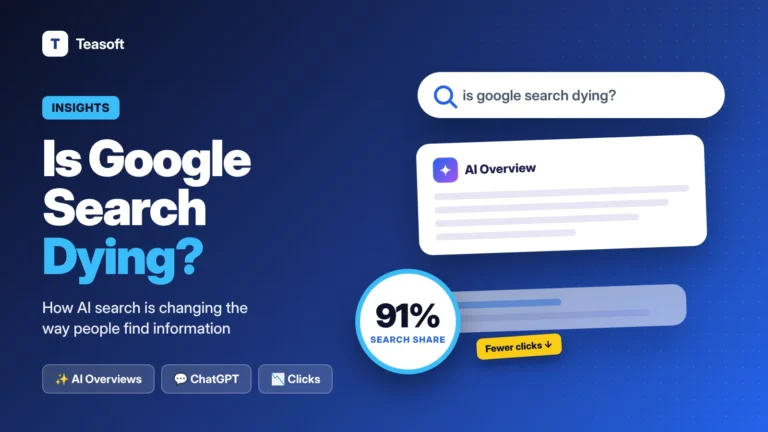
| 91% | of search still goes to Google | StatCounter, Oct 2026 |
| 2.5B+ | monthly AI Overviews users | Google, May 2026 |
| ~9 in 10 | companies use AI somewhere | McKinsey, 2026 |
| $581.7B | corporate AI investment in 2025 | Stanford AI Index |
| 78M | net new jobs expected by 2030 | WEF |
AI Usage Statistics
- 11.2 billion people use ChatGPT and other OpenAI products every week.Source: OpenAI, Sept 2026
- 22.6 billion messages are sent to ChatGPT every day.Source: OpenAI and NBER study, June 2025
- 31 billion people now use the Gemini app.Source: Alphabet Q3 2026 results
- 453% of people adopted generative AI within three years of its mass-market launch.Source: Stanford AI Index, 2026
- 549% of US adults now use AI chatbots, up from 33% in 2024.Source: Pew Research Center, 2026
- 624% of US adults use AI chatbots every day.Source: Pew Research Center, 2026
- 744% of US adults have used ChatGPT, up from 18% in 2023.Source: Pew Research Center, 2026
- 857% vs 28% of US adults under 50 have used ChatGPT, compared with those 50 and older.Source: Pew Research Center, 2026
- 924% · 17% · 6% of US adults have used Gemini, Copilot and Claude respectively, behind ChatGPT at 44%.Source: Pew Research Center, 2026
- 104 in 5 US high school and university students use generative AI for schoolwork.Source: Stanford AI Index, 2026

AI Statistics for India
- 11100 million+ people in India used ChatGPT every week as of February 2026.Source: TechCrunch, Feb 2026
- 12#1 India is now ChatGPT’s largest market by weekly users, and its user base doubled between January and November 2026.Source: Inc42, Nov 2026
- 13Most students India has the largest number of student ChatGPT users in the world, according to OpenAI CEO Sam Altman.Source: TechCrunch, Feb 2026
- 1480%+ of employees in India use AI at work regularly, among the highest rates in the world.Source: Stanford AI Index, 2026
- 15+14 points rise in the share of Indians who feel nervous about AI from 2024 to 2025, while excitement rose 2 points.Source: Stanford AI Index, 2026
AI Search Statistics
- 1691.05% of worldwide search engine use still goes to Google.Source: StatCounter, Oct 2026
- 175-year high Google’s search query growth in Q3 2026 was the fastest in five years.Source: Alphabet Q3 2026 results
- 182.5 billion+ people see Google’s AI Overviews every month.Source: Google I/O, May 2026
- 191 billion+ people use Google’s AI Mode every month.Source: Alphabet, July 2026
- 2060% of US adults read the AI summaries at the top of search results.Source: Pew Research Center, 2026
- 218% vs 15% Searchers click a regular result in 8% of visits when an AI summary appears, compared with 15% without one.Source: Pew Research Center, 2025
- 221% of visits with an AI summary include a click on a link inside the summary.Source: Pew Research Center, 2025
- 230.46% of website visits came from AI assistants in October 2026, up from 0.27% in June 2025.Source: Ahrefs data, Oct 2026
- 24$63.35 billion Google Search revenue in Q3 2026, up 12% year on year.Source: Alphabet Q3 2026 results
- 2525% drop in search engine volume by 2026 was predicted by Gartner in 2024, but Google’s queries kept growing.Source: Gartner, 2024
AI in Business Statistics
- 26~9 in 10 organisations use AI in at least one business function.Source: McKinsey State of AI, 2026
- 2744% of organisations are scaling AI across the enterprise, up from 38% a year earlier.Source: McKinsey State of AI, 2026
- 2840% of large organisations are scaling AI agents in at least one function, up from 27%.Source: McKinsey State of AI, 2026
- 2937% of organisations say AI has contributed positively to their profits (EBIT).Source: McKinsey State of AI, 2026
- 306% of organisations are “AI high performers”, getting at least 5% of EBIT from AI.Source: McKinsey State of AI, 2026
- 3160% of organisations expect to increase AI investment next year.Source: McKinsey State of AI, 2026
- 3232% of organisations decided not to buy a software product because they could build it with AI in-house.Source: McKinsey State of AI, 2026
- 33$581.7 billion in corporate AI investment in 2025, up 130% in a year.Source: Stanford AI Index, 2026
- 34$285.9 billion in private AI investment in the US in 2025, far ahead of any other country.Source: Stanford AI Index, 2026
- 3520% of all business technology spending will go to AI in 2027, Forrester predicts.Source: sources in our AI trends 2027 report
- 3640%+ of agentic AI projects will be cancelled by the end of 2027, Gartner predicts.Source: sources in our AI trends 2027 report
AI and Jobs Statistics
- 37170M vs 92M jobs expected to be created vs displaced by 2030, a net gain of 78 million (World Economic Forum).Source: sources in our AI jobs analysis
- 3840% of jobs worldwide are exposed to AI, rising to about 60% in advanced economies (IMF).Source: sources in our AI jobs analysis
- 3958% of employees worldwide use AI at work regularly or semi-regularly.Source: Stanford AI Index, 2026
- 4026% productivity gain in software development from AI, and 14–15% in customer support.Source: Stanford AI Index, 2026
- 41−20% fall in employment for US software developers aged 22–25 since 2024.Source: Stanford AI Index, 2026
- 42~121,000 US job cuts announced from January to October 2026 were attributed to AI, about 20% of all cuts (Challenger, Gray & Christmas).Source: sources in our AI jobs analysis
- 4380% of organisations say AI has improved individual employee productivity.Source: McKinsey State of AI, 2026
- 4439% of organisations expect AI to reduce their headcount next year, up from 32%.Source: McKinsey State of AI, 2026
AI Public Opinion Statistics
- 4563% of Americans say AI is advancing too quickly. Only 2% say too slowly.Source: Pew Research Center, 2026
- 4671% of Americans say AI makes their personal information less secure.Source: Pew Research Center, 2026
- 4740% vs 16% of Americans expect AI to have a negative vs positive impact on society over the next 20 years.Source: Pew Research Center, 2026
- 4859% of people worldwide say AI products offer more benefits than drawbacks, up from earlier years.Source: Stanford AI Index, 2026
- 4973% vs 23% of AI experts vs the US public expect AI to have a positive impact on jobs.Source: Stanford AI Index, 2026
- 5030% vs 5% of Americans say chatbots help vs hurt their productivity.Source: Pew Research Center, 2026
How We Collected These AI Statistics
- Primary sources first: official reports and company statements from Pew Research Center, McKinsey, Stanford HAI, Google, Alphabet and OpenAI.
- Dated and linked: every number shows where and when it was published, because AI numbers change fast.
- Forecasts are labelled: predictions from Gartner, Forrester, the WEF and the IMF are estimates, not measurements.
- Kept up to date: we review this page regularly and replace numbers when newer reports come out.
Frequently Asked Questions
How many people use AI in 2026?
ChatGPT and other OpenAI products reach about 1.2 billion people a week, the Gemini app has about 1 billion users, and Google’s AI Overviews reach more than 2.5 billion people a month. In the US, 49% of adults use AI chatbots.
How many people use ChatGPT in India?
OpenAI said India had more than 100 million weekly ChatGPT users in February 2026, and by November 2026 India had become ChatGPT’s largest market, with its user base doubling since January.
What percentage of companies use AI?
McKinsey’s 2026 State of AI survey found nearly nine in ten organisations use AI in at least one business function, and 44% are scaling it across the enterprise. Only about 6% are high performers getting large profit gains.
Will AI take jobs?
The World Economic Forum expects 170 million jobs to be created and 92 million displaced by 2030, a net gain of 78 million. AI changes many jobs, with entry-level roles in exposed fields feeling it first.
Is AI search replacing Google?
Not yet. Google still handles about 91% of global search and its queries are growing, but AI answers now appear inside Google and people click fewer links when an AI summary appears.
How often are these AI statistics updated?
We review this page regularly and update numbers when major new reports are published, such as the Stanford AI Index, McKinsey’s State of AI and Pew Research Center surveys.
Final Takeaway: AI Is Everywhere, Value Is Not (Yet)
The numbers tell a clear story. AI use has grown faster than almost any technology before it, in homes, schools and offices, and nowhere faster than in India. But trust is falling, clicks to websites are dropping, and most companies are still waiting for real returns.
The people who benefit most will be those who learn to use AI tools well and check what they produce. Bookmark this page for the latest AI statistics, and share it with anyone who needs real numbers instead of headlines.
Find the right AI tool for you
Honest reviews and comparisons of ChatGPT, Gemini, Claude, Perplexity and more, plus free guides to get better results.