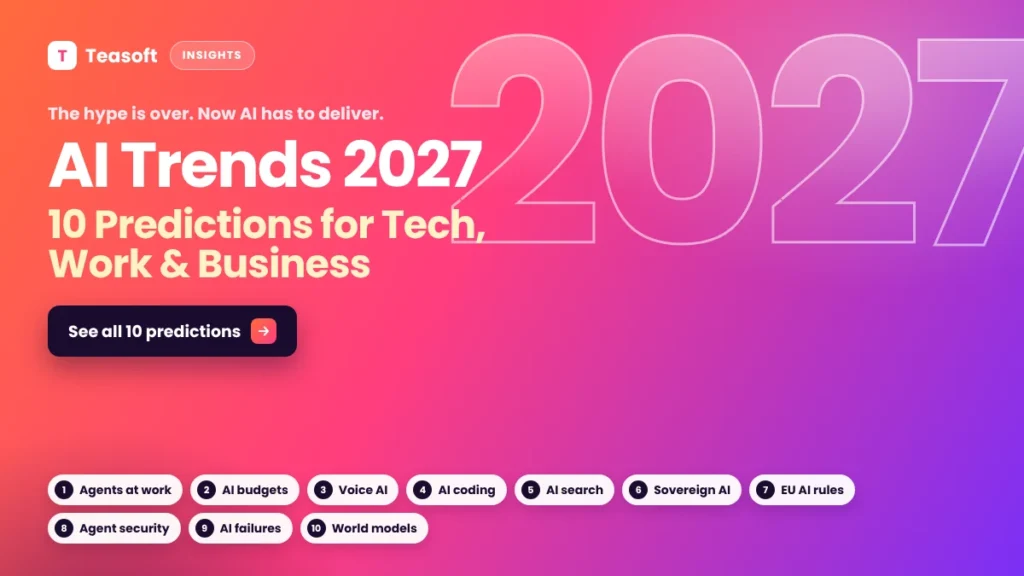
The biggest AI trends for 2027 are AI agents moving into everyday work (with many projects failing along the way), AI taking around a fifth of business tech budgets, voice becoming a main way to use AI, AI writing a large share of software, AI search replacing more Google clicks, countries like India building their own “sovereign” AI, Europe’s high-risk AI rules arriving in December 2027, and new security and reliability risks from autonomous AI. Robots and “world models” will grow, but mostly after 2027.
2026 was the year AI went from chatbots to tools that act on their own. So what comes next? We went through the newest forecasts from Gartner and Forrester, Stanford’s 2026 AI Index, Europe’s updated AI rules and India’s AI Mission to pick the 10 AI trends most likely to shape 2027. These AI trends 2027 predictions are based on published research, not guesswork.
For each prediction you’ll find what is driving it, how likely we think it is, and what it means for you, whether you’re a student, a professional or running a business.

AI Trends 2027: The Summary Table
| # | Prediction for 2027 | Likelihood | Who feels it most |
|---|---|---|---|
| 1 | AI agents go to work, and many agent projects get cancelled | High | Businesses, office workers |
| 2 | AI reaches about 20% of business tech spending | High | Companies, IT teams |
| 3 | Voice becomes a main way to use AI | Medium–High | Everyone, customer service |
| 4 | AI writes a big share of the world’s code | High | Developers, students |
| 5 | AI answers replace more search clicks | High | Website owners, marketers |
| 6 | Countries build their own “sovereign AI” | High | India, Europe, governments |
| 7 | AI rules get real: EU high-risk rules from 2 Dec 2027 | High | HR, banks, schools, startups |
| 8 | AI agents become a top security risk | Medium–High | IT and security teams |
| 9 | An AI-caused failure makes global headlines | Medium | Everyone |
| 10 | AI moves beyond text into robots and “world models” | Medium (bigger after 2027) | Factories, logistics, research |
1. AI Agents Go to Work, and Many Projects Fail
AI agents are AI tools that don’t just answer questions but take actions: booking, filing, coding, replying to customers. They are improving fast. Stanford’s 2026 AI Index found agent success on a popular computer-use test (OSWorld) jumped from about 12% to about 66% in a year, yet agents still fail roughly one task in three, and real deployment in most business functions is still in single digits.
That gap explains the first of our AI trends 2027 predictions: agents will spread into everyday software, but many company projects will be scrapped. Gartner predicts that more than 40% of agentic AI projects will be cancelled by the end of 2027 because of rising costs, unclear value or weak risk controls.
2. AI Takes a Fifth of Business Tech Budgets
Forrester predicts that in 2027 AI will account for 20% of all business technology spending, with total global tech spending forecast at about $6.1 trillion. The money is already flowing: Stanford’s AI Index reports corporate AI investment of about $581.7 billion in 2025, up 130% in a year.
The catch is that bosses will want results, which is a theme across all the AI trends 2027 is likely to bring. With so much money going in, 2027 is likely to be the year companies cut AI projects that can’t show clear savings or revenue.
3. Voice Becomes a Main Way to Use AI
New “speech reasoning” models think directly in audio instead of turning speech into text first, so conversations feel faster and more natural. Gartner lists them among its top technology trends for 2027 and predicts that by 2030 over 70% of enterprise voice interactions will be handled autonomously, up from under 10% in 2026.
Among AI trends 2027 will bring to everyday life, this one is easy to notice: more AI phone agents for banks, airlines and delivery apps, and more people talking to assistants in their own language instead of typing. For a country with as many languages as India, voice-first AI could reach millions of new users.
4. AI Writes a Big Share of the World’s Code
Of all the AI trends 2027 will push forward, coding is where AI has improved fastest. Stanford reports that AI performance on the SWE-bench Verified coding test rose to nearly the human baseline in a single year, and Gartner predicts autonomous coding agents will generate 20% of all public code commits by late 2026. Gartner also expects companies to adopt “coding agent harnesses” with checks and tests that keep AI-written code safe.
The flip side shows up in hiring: Stanford found employment of US developers aged 22 to 25 fell nearly 20% from 2024, while demand for experienced developers kept growing. We covered this in detail in Will AI Take Your Job?
5. AI Answers Replace More Search Clicks
Generative AI reached about 53% of the world’s population within three years, according to Stanford, faster than the PC or the internet. More of those people now ask ChatGPT, Gemini or Google’s AI Overviews instead of clicking through to websites.
In 2027 we expect more searches to end with an AI-written answer, and more websites to compete to be one of the few sources it cites. Ranking on Google will still matter, but being quotable by AI will matter just as much.
6. Countries Build Their Own “Sovereign AI”
More governments want AI they control: models trained on local languages and data, running on local computers. Gartner lists “sovereign tech” as a top trend for 2027 and predicts that by 2030 more than 75% of organisations outside the US will have digital sovereignty strategies.
India is a clear example of this AI trend for 2027. Under the IndiaAI Mission, more than 38,000 GPUs have been made available to startups and researchers at subsidised rates, and Indian models such as Sarvam AI and BharatGen’s Param2, which supports 22 Indian languages, were showcased at the AI Impact Summit in February 2026. Expect more Indian-language AI tools in 2027.
7. AI Rules Get Real
Europe’s AI Act was updated in July 2026 by the “AI Omnibus” (summary of the changes). Its main high-risk rules, for AI used in hiring, education, credit scoring and similar areas, now apply from 2 December 2027, and rules for AI built into regulated products such as medical devices follow on 2 August 2028.
That makes late 2027 a big deadline for any company selling AI into Europe, including Indian IT and software firms. Public trust is the other driver: Stanford found only 31% of Americans trust their government to regulate AI, so pressure for clearer rules will keep growing everywhere.
8. AI Agents Become a Top Security Risk
When AI agents can log in, send emails and move data, they become a target. Gartner lists “AI agent identity” as a 2027 trend and predicts that by 2028, 25% of enterprise security breaches will trace back to AI agent abuse. Attackers will try to trick agents with hidden instructions in emails, documents and web pages.
On the defence side, Gartner expects AI that automatically finds and fixes security holes, shrinking the time attackers have to exploit them.
9. An AI-Caused Failure Makes Global Headlines
As more code and decisions come from AI, mistakes can spread faster. This is the AI trend for 2027 nobody wants, but it’s worth planning for. Among its predictions for 2027, Forrester warns that an AI-generated bug could cause a major outage across several industries at once. Whether or not that exact event happens, we expect at least one high-profile AI failure in 2027 to push companies toward more testing and human sign-off.
10. AI Moves Beyond Text Into Robots and “World Models”
The last of our AI trends 2027 predictions looks further ahead. The next wave of AI isn’t just about words. “World models” let AI simulate what will happen before it acts, which is key for robots and self-driving systems. Gartner predicts that by 2030, 40% of robotics applications will use world models, up from under 1% in 2025. It also highlights new “large quantitative models” built for numbers and forecasting rather than text.
In 2027 expect impressive demos and early use in warehouses, factories and research labs. Robots in most homes and offices are still further away.
What Probably Won’t Happen in 2027
- AI won’t replace most jobs overnight. Changes will keep showing up as fewer entry-level hires and changed tasks, not mass layoffs.
- Agents won’t run whole companies. They will handle more tasks, but with humans checking the important ones.
- Hallucinations won’t disappear. AI will keep getting facts wrong sometimes, so checking sources stays essential.
- Humanoid robots won’t be in most homes. Expect demos and pilots, not mass adoption.
How to Prepare for AI Trends 2027
- Use AI every week in your study or work so it feels normal. Start with the best free AI tools.
- Learn to write good prompts. Our free ChatGPT cheat sheet has 110 ready-made prompts.
- Practise checking AI output: facts, numbers, code and sources. This is the skill that keeps humans in charge.
- Protect your accounts. Give AI tools only the access they need, and use strong, unique passwords.
- Build skills AI can’t easily copy: judgment, communication, leadership and deep knowledge of your field.
Frequently Asked Questions
What are the biggest AI trends for 2027?
The biggest AI trends for 2027 are AI agents in everyday work, AI taking about 20% of business tech budgets, voice AI, AI-written code, AI search replacing more clicks, sovereign AI in countries like India, Europe’s high-risk AI rules from 2 December 2027, AI agent security risks, and early growth in robots and world models.
Will AI agents replace workers in 2027?
Not on a large scale. Agents will take over more tasks, but they still fail often on complex work, and Gartner predicts over 40% of agentic AI projects will be cancelled by the end of 2027. Most roles will change rather than disappear.
When do the EU AI Act high-risk rules start?
After the July 2026 AI Omnibus update, rules for stand-alone high-risk AI systems, such as AI used in hiring, education and credit scoring, apply from 2 December 2027. Rules for AI built into regulated products like medical devices apply from 2 August 2028.
What is sovereign AI?
Sovereign AI means AI models and computing that a country or organisation controls itself, often trained on local languages and data. India’s IndiaAI Mission, with over 38,000 GPUs and models like BharatGen’s Param2 for 22 Indian languages, is one example.
How should students prepare for AI in 2027?
Use AI tools regularly, learn to write clear prompts, practise checking AI answers for errors, and build skills like communication, judgment and deep subject knowledge that AI can’t easily copy.
Is AI investment still growing?
Yes. Stanford’s 2026 AI Index reports corporate AI investment of about $581.7 billion in 2025, up 130% from the year before, and Forrester expects AI to reach 20% of business technology spending in 2027.
Final Takeaway: 2027 Is the Year AI Has to Prove Itself
The AI trends 2027 is set to bring all point in one direction: AI is moving from impressive demos into real work, real budgets and real rules. That means bigger rewards for people and companies who use it well, and less patience for projects that don’t deliver.
You don’t need to predict the future perfectly to benefit from it. Pick one trend from this list that affects you most, learn one new AI skill this month, and you’ll be ahead of most people when 2027 arrives.
Stay ahead of AI in 2027
Explore hands-on reviews of the AI tools behind these trends, compare them side by side and find the right one for your work.

Amandeep Bindra is the Founder of AdBindra Corporation, the parent company of Teasoft. With over a decade in web development, AI and digital marketing, he shares practical, tested insights on AI tools, web technology and productivity.