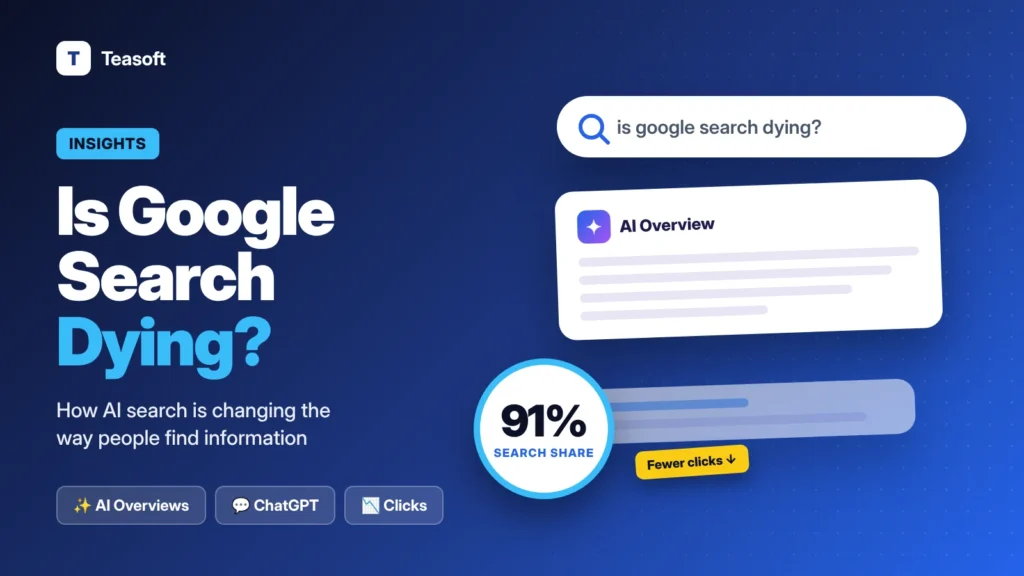
No, Google Search is not dying. It still handles about 91% of the world’s search engine use, and Google says query growth in 2026 is the fastest in five years. What is changing is how people find information. AI answers now appear inside Google (AI Overviews has over 2.5 billion monthly users and AI Mode over 1 billion), ChatGPT reaches about 1.2 billion people a week, and people click fewer links when an AI summary appears. Search isn’t disappearing. It is turning from a list of links into a conversation.
“Google is dead” headlines have been around since ChatGPT launched in late 2022. Analysts predicted search volume would collapse, and Apple even said searches in Safari fell for the first time in over 20 years. So is Google search dying, or are people just searching in new ways?
We looked at the latest data from Google, OpenAI, Pew Research Center, StatCounter and Ahrefs to separate the hype from what’s really happening, and what it means for you as a user and as a website owner.

AI Search vs Google: The Numbers at a Glance
| Metric | Latest figure | Source |
|---|---|---|
| Google’s share of worldwide search engine use | 91.05% (Oct 2026), up from 90.04% a year earlier | StatCounter |
| Google search query growth | Fastest year-on-year growth in 5 years (Q3 2026) | Alphabet |
| Google Search & other revenue | $63.35 billion in Q3 2026, up 12% | Alphabet |
| AI Overviews users | 2.5 billion+ a month (May 2026) | |
| AI Mode users | 1 billion+ a month (July 2026) | Alphabet |
| ChatGPT and OpenAI products | About 1.2 billion weekly users (Sept 2026) | OpenAI |
| Clicks when an AI summary appears | 8% of visits vs 15% without one | Pew Research Center |
| Website visits from AI assistants | 0.46% of visits (Oct 2026), up from 0.27% | Ahrefs data |
1. Google Is Still Growing, Not Dying
If Google search were dying, you would see it in the numbers first. You don’t. According to StatCounter, Google handled 91.05% of worldwide search engine use in October 2026, slightly up from 90.04% a year earlier. In its Q3 2026 results, Alphabet reported Search & other revenue of $63.35 billion, up 12% year on year, and CEO Sundar Pichai said search query growth was “the highest it’s been in the last five years.”
In other words, people are searching on Google more, not less. AI features seem to make people ask more questions, not fewer.
2. AI Answers Now Sit Inside Google Itself
The biggest competitor to classic Google search is… Google’s own AI. AI Overviews, the AI-written summaries at the top of many results, reached more than 2.5 billion monthly users, Google said at I/O in May 2026. AI Mode, the chat-style search tab, passed 1 billion monthly users within about a year of launch, according to Alphabet’s July 2026 earnings call. The Gemini app has also reached one billion users.
So when people say they now “ask AI instead of Googling”, many of them are still using Google. The search box is the same, but the answer looks completely different. The change has a cost for Google too: its CFO said “monetization in AI Mode is lower”, and fast AI Mode growth weighed on Search revenue, which grew 12% in Q3 2026, down from 17% in Q2.
3. Fewer Clicks: The Real Change for Websites
The real story isn’t fewer searches. It’s fewer clicks. A Pew Research Center study tracked the real browsing of 900 US adults and found that people clicked a regular search result in only 8% of visits when an AI summary appeared, compared with 15% when there was no summary. They clicked a link inside the AI summary in just 1% of visits, and were more likely to end their browsing session altogether (26% vs 16%).
SEO tool makers see the same pattern. Ahrefs found the top-ranking page gets a much lower click-through rate when an AI Overview appears above it. For many websites, ranking first is no longer enough on its own.
4. ChatGPT and AI Assistants Are a Second Front Door
Outside Google, AI assistants have grown faster than any app before them. OpenAI said in September 2026 that its products reach about 1.2 billion people a week. Many of those conversations are what used to be searches: “Which laptop should I buy?”, “How do I fix this error?”, “Plan a 3-day trip to Goa.”
But for websites, AI assistants are still a small source of visitors. In Ahrefs data across more than 118,000 websites, AI assistants sent 0.46% of visits in October 2026, up from 0.27% in June 2025. Google still sent roughly 55 visits for every 1 from all AI assistants combined. The share is small, but it is growing fast, and those visitors often arrive ready to act.
5. Predictions vs Reality: What the Experts Got Wrong
In February 2024, Gartner predicted that traditional search engine volume would drop 25% by 2026 because of AI chatbots. In May 2025, Apple’s Eddy Cue said searches in Safari had fallen for the first time in over 20 years, which sent Alphabet’s shares down.
The data since then tells a more mixed story. Google’s overall query growth is at a five-year high, and its global share has held above 90%. But the type of search has changed: more questions are answered by AI on the results page, and fewer of them send people to websites. The predictions were wrong about search disappearing, and right that the old “10 blue links” model was ending.

What This Means for Everyday Users
- You’ll get faster answers. Simple questions, like opening hours, definitions and conversions, are now answered instantly without clicking.
- You need to check more. AI answers can be confidently wrong. For anything important, open at least one trusted source.
- You can ask follow-up questions. AI Mode, ChatGPT and Gemini let you refine a search like a conversation, which saves time on complex questions.
- Your choice of tool matters. Use Google for local results, shopping and fresh news, and AI assistants for planning, explaining and drafting. See our list of the best free AI tools.
What This Means for Website Owners and Creators
- Answer the question first. Put a short, direct answer at the top of each page, like the Quick Answer on this one. AI tools quote clear answers.
- Show your sources and experience. Cite data, name the author and update pages when facts change. Trust signals matter more when AI decides who to quote.
- Use structure. Clear headings, tables, FAQs and schema markup make your content easy for both Google and AI tools to understand.
- Check if AI can find you. Follow our guide on how to get found in AI search and score your pages with the free AI search optimization checklist.
- Track AI traffic. Watch referrals from chatgpt.com, perplexity.ai and gemini.google.com in your analytics, alongside Google.
What Probably Won’t Happen
- Google won’t disappear soon. With over 90% global share and growing queries, it will remain the main way most people find websites for years.
- Websites won’t become pointless. AI answers are built from websites. Original, trustworthy content becomes more valuable, not less.
- One AI won’t win everything. People will mix Google, ChatGPT, Gemini, Perplexity and apps like YouTube and Instagram depending on the task.
- AI answers won’t become perfect. Mistakes will keep happening, so checking sources stays important.
Frequently Asked Questions
Is Google search dying?
No. Google still handles about 91% of worldwide search engine use, and Alphabet says search query growth in 2026 is the fastest in five years. What is changing is how results look: AI answers now appear at the top, and people click fewer links.
How is AI changing the way people search?
People now ask full questions and get AI-written answers, either inside Google through AI Overviews and AI Mode, or in assistants like ChatGPT and Gemini. They ask follow-up questions and click links mainly to verify, buy or book.
How many people use AI Overviews and AI Mode?
Google says AI Overviews has more than 2.5 billion monthly users (May 2026), and AI Mode passed 1 billion monthly users within about a year of launch (July 2026).
Is ChatGPT replacing Google?
Not yet. ChatGPT and other OpenAI products reach about 1.2 billion people a week, but Google still sends around 55 website visits for every 1 visit from all AI assistants combined. Most people use both, for different tasks.
Do AI Overviews reduce clicks to websites?
Yes. Pew Research Center found that people clicked a regular search result in 8% of visits when an AI summary appeared, compared with 15% without one, and clicked a link inside the summary in only 1% of visits.
How can my website get traffic from AI search?
Put clear, direct answers at the top of your pages, cite sources, show who wrote the content, use headings, tables and FAQs, and add schema markup. Teasoft’s free AI search guide and checklist walk you through each step.
Final Takeaway: Search Isn’t Dying, It’s Changing Shape
Google search is not dying. More people are searching than ever. But search is turning from a list of links into a conversation with AI, both inside Google and in tools like ChatGPT. That means faster answers for users, and fewer, more valuable clicks for websites.
The winners will be people who learn to use AI search well and check its answers, and websites that give clear, trustworthy answers worth quoting.
Get your website ready for AI search
Learn how AI tools choose which sites to quote, then score your pages with our free 30-point checklist.