Will AI take your job? For most people, not any time soon. So far the data shows no economy-wide wave of AI job losses, and big forecasts expect AI to create more jobs than it removes. The real change is quieter: AI is taking over tasks, and companies are hiring fewer entry-level workers in AI-exposed roles like customer support, writing and junior coding. Your risk depends on your tasks, not your job title.
Every week brings a new headline saying AI is coming for everyone’s job. Then the next week, someone says it’s all hype. No wonder so many people are asking: will AI take your job, or not?
So we set the opinions aside and looked at the numbers: global forecasts from the World Economic Forum, the IMF and Goldman Sachs, and real job data from Stanford, Yale, the Chicago Fed, Challenger and India’s Economic Survey. Here’s what the data actually shows, which jobs are most exposed, and a quick self-check to see where you stand.

What the Big Forecasts Say
Most of the scary numbers you see come from forecasts about what AI could do. Here are the most quoted ones and what they really mean:
| Source | Headline number | What it really means |
|---|---|---|
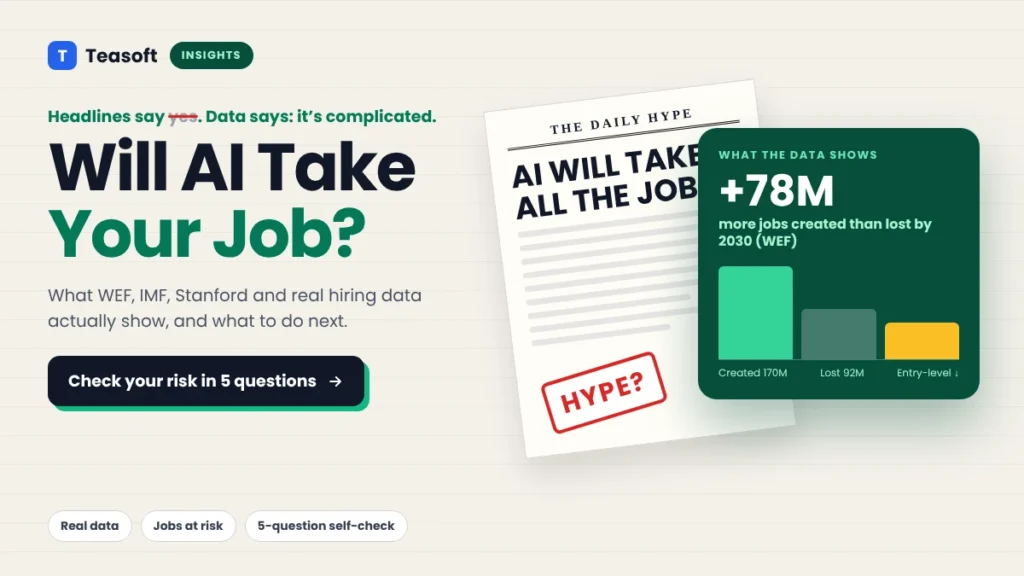
| World Economic Forum | 170M jobs created, 92M displaced by 2030 | A net gain of 78M jobs, but many people will need to switch roles or learn new skills. |
| IMF | About 40% of jobs worldwide exposed to AI | Rises to about 60% in advanced economies. Exposed means affected, and roughly half of those jobs may benefit from AI rather than lose out. |
| Goldman Sachs | 300M jobs exposed worldwide | Their estimate is that 6–7% of US workers could be displaced if AI is widely adopted, spread over about a decade. |
Notice the key word: exposed. A job is “exposed” when AI can do some of its tasks. That usually means the job changes, not that it disappears. A translator who uses AI for first drafts is exposed, but still employed. So when a headline asks “will AI take your job?”, check whether it’s quoting exposure or actual job losses.
What the Job Data Actually Shows So Far
Forecasts are guesses. To really answer “will AI take your job?”, we need employment data, which tells us what has really happened since ChatGPT launched in late 2022:
- No economy-wide disruption yet. Researchers at the Yale Budget Lab found that the mix of jobs in the US hasn’t shifted faster than in past tech waves, and people in AI-exposed jobs aren’t staying unemployed longer (Fortune).
- AI-exposed jobs have grown. Federal Reserve Bank of Chicago research found employment in the occupations most exposed to AI rose about 4% from 2019 to 2024, and wages rose across the board.
- Most workers haven’t felt it. In a FlexJobs survey of 4,451 US workers, 75% said AI hasn’t changed their job, and only 6% said their own role changed because of AI (FlexJobs).
- India sees the same pattern. India’s Economic Survey 2025–26 says AI has not caused mass job losses so far and is more likely to support workers in the near term, while warning that caution is still needed.
The Real Warning Sign: Fewer Entry-Level Jobs
If there is one number to watch, it’s this one. Stanford’s Digital Economy Lab tracks young workers in jobs that are highly exposed to AI, such as software development and customer service. In its latest update, employment for 22 to 25-year-olds in these roles is about 19% below where it would be if it had kept pace with similar workers in less-exposed jobs, up from about 15% a year earlier.
Two details matter:
- It’s about hiring, not firing. The drop comes mainly from companies hiring fewer juniors, not from laying people off.
- Experienced workers are fine so far. Older workers in the same jobs haven’t seen a similar decline. Their judgment and know-how are harder for AI to copy than textbook knowledge.
So, will AI take your job if you’re already working? Probably not directly. Will it make it harder to get your first job in an AI-exposed field? The data says yes, it already is.
AI Layoffs and “AI Washing”: Read the Headlines Carefully
Layoff trackers do show AI being named more often. According to Challenger, Gray & Christmas, US employers cited AI for about 121,000 announced job cuts from January to October 2026, roughly 20% of all announced cuts, making it the second most common reason after market and economic conditions.
That sounds alarming, but before you decide whether AI will take your job based on layoff news, keep two things in mind:
- It’s a small slice of the workforce. The US has more than 160 million workers, and announced cuts are not the same as people who stay jobless.
- “AI washing” is real. Economists say some companies blame AI for layoffs that are really about over-hiring, costs or economic uncertainty, because “we’re investing in AI” sounds better to investors than “business is slow.”
Jobs Most and Least at Risk from AI
A Microsoft Research study of real Copilot conversations ranked jobs by how much their tasks overlap with what AI can do (The Register). Combined with the hiring data above, a clear pattern appears:

| Exposure | Example jobs | Why |
|---|---|---|
| Higher | Customer service, translators, writers, sales reps, data entry, junior coders | Work is mostly text, information and repeatable steps that AI handles well. |
| Mixed | Marketers, accountants, lawyers, designers, senior developers | AI speeds up parts of the work, but judgment, clients and accountability stay human. |
| Lower | Electricians, plumbers, nurses, care workers, construction, skilled trades | Physical skill, on-site decisions and human trust are hard for AI to copy. |
High exposure doesn’t mean doomed. It means the job is changing fastest. If you’re in this group and wondering “will AI take your job?”, the honest answer is that it will change it first, and the people who learn to use AI well in these roles often become more valuable, not less.
Will AI Take Your Job? A 5-Question Self-Check
Answer these honestly. The more times you say “yes”, the more your current tasks overlap with AI:
- Is most of my day spent on a screen with text, numbers or documents?
- Could someone write down my tasks as clear step-by-step rules?
- Is my work judged mainly on speed and volume, not on judgment or relationships?
- Could I do my whole job remotely without ever meeting anyone in person?
- Is my role entry-level or mostly about producing first drafts for someone else?
0–1 yes: low exposure. AI will be a helper, not a threat. 2–3 yes: your job will change. Start learning AI tools now. 4–5 yes: high exposure. Move toward the parts of your work that need judgment, people and ownership.
How to Stay Valuable as AI Spreads
The people most at risk aren’t those whose jobs use AI. They’re the ones who refuse to. The best answer to “will AI take your job?” is to become the person who uses AI best. Here’s what helps:
- Use AI every day in your current job. Start with free tools. Our list of the best free AI tools covers writing, research, design, video and voice.
- Move up from tasks to outcomes. AI can write the draft. You decide what’s right, fix it and take responsibility for the result.
- Build human skills on purpose. Communication, negotiation, leadership and client trust are getting more valuable as routine work gets automated.
- Go deep in your field. Stanford’s data shows experience protects workers. Know-how that isn’t written down anywhere is hard for AI to copy.
- Show your work online. A portfolio, blog or LinkedIn presence helps people and AI search tools find you. See our guide on how to get found in AI search.
- If you’re early in your career, pick roles with real-world contact, build projects that show judgment, and learn tools like ChatGPT and Claude well enough to deliver more than a junior could alone.
Frequently Asked Questions
Will AI take your job?
For most people, not soon. Real job data shows no economy-wide wave of AI job losses so far, and the World Economic Forum expects 170 million jobs to be created and 92 million displaced by 2030. AI is more likely to change your tasks than remove your job, especially if you learn to use it.
Which jobs are most at risk from AI?
Jobs built on text, data and repeatable rules have the highest exposure, such as customer service, translation, writing, data entry, some sales roles and junior coding. Hands-on jobs like electricians, nurses, care workers and construction trades have the lowest exposure.
Is AI already causing job losses?
In some places, yes, but less than headlines suggest. Employers named AI in roughly 20% of announced US job cuts from January to October 2026, yet studies from Yale and the Chicago Fed find no broad disruption, and some companies blame AI for cuts that have other causes.
Are young workers more at risk from AI?
Yes. Stanford research finds employment for 22 to 25-year-olds in highly AI-exposed jobs is about 19% below the expected trend, mostly because companies are hiring fewer juniors. Experienced workers in the same jobs have not seen a similar drop.
How can I make sure AI won’t take my job?
The best way to stop AI from taking your job is to work with it. Use AI tools in your daily work, focus on tasks that need judgment and responsibility, build people skills like communication and leadership, and deepen your expertise. Workers who use AI well usually become more productive and harder to replace.
Will AI create new jobs?
Yes. The World Economic Forum expects a net gain of about 78 million jobs by 2030, with fast growth in AI and data roles, cybersecurity, green energy and care work, plus many existing jobs that will be redesigned around AI.
Final Takeaway: AI Changes Jobs Before It Replaces Them
So, will AI take your job? The honest answer from the data is: probably not in one big wave, but it is already reshaping tasks and squeezing entry-level hiring in AI-exposed fields. The biggest risk isn’t AI itself. It’s standing still while the people around you learn to work with it.
Take the self-check above, pick one AI tool to use every day this week, and put your energy into the parts of your work that need a human: judgment, relationships and ownership.
Start using AI before it changes your job
Find free, beginner-friendly AI tools for writing, research, design and more, with hands-on reviews and side-by-side comparisons.

Amandeep Bindra is the Founder of AdBindra Corporation, the parent company of Teasoft. With over a decade in web development, AI and digital marketing, he shares practical, tested insights on AI tools, web technology and productivity.