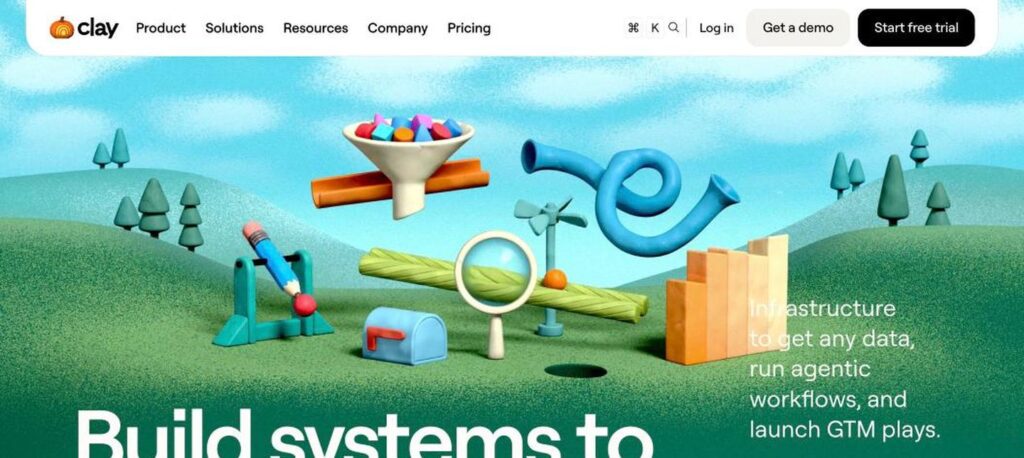
Clay is a go-to-market data platform for finding and enriching leads. It combines data from many providers in waterfalls, uses its Claygent AI agent to research companies and people on the web, and automates prospecting workflows and outreach. There is a free plan, and Launch starts at $167 a month billed yearly.
What is Clay?
Clay has become one of the most talked-about tools in sales and growth teams. It works like a spreadsheet where every column can pull data or run an action: find a company’s domain, look up a contact’s email or phone number, check job changes or ask an AI agent to research something specific.
Clay’s waterfall enrichment tries multiple data providers one after another until it finds the data, which improves coverage. Claygent, its AI research agent, can browse websites to answer custom questions about leads. Teams then use the data to build lists, score leads, personalize messages and sync results to their CRM.
Clay key features
Waterfall enrichment
Query many data providers in order to find more emails and phones.
Claygent AI agent
Research companies and people with an AI web agent.
Spreadsheet workflows
Build enrichment and automation in a table interface.
Audiences search
Find target companies and contacts at scale.
Signals
Track job changes, hiring and other buying signals.
AI personalization
Write personalized messages for each lead.
Email sending
Send outreach through Clay or connected tools.
CRM sync
Sync and enrich records in your CRM (Growth plan).
API and webhooks
Connect Clay to your own systems and data.
Clay pricing plans (2026)
Clay has a free plan and two self-serve plans that scale with usage, plus Enterprise. Prices below are starting prices billed yearly, which saves 10%. Usage is measured in actions and data credits.
Free
6,000 actions a year, 1,200 data credits, unlimited seats, Claygent and up to 200 rows per table.
Launch
From 180,000 actions a year, phone enrichment, signals, Audiences search and email sending.
Growth
From 480,000 actions a year, CRM sync, web intent signals, HTTP API and priority support.
Enterprise
Unlimited search, SSO, SCIM, RBAC, credit budgeting and a dedicated strategist.
Prices rise with the number of actions and data credits you choose. Check the latest prices on the official Clay pricing page.
How to use Clay
- 1
Go to clay.com and sign up for free.
- 2
Create a table and import a list or search for companies.
- 3
Add enrichment columns to find emails, phones and company data.
- 4
Use Claygent to research custom details about each lead.
- 5
Personalize outreach and sync results to your CRM or email tool.
Who should use Clay?
Sales teams
Build targeted lead lists with rich data.
Growth marketers
Automate prospecting and personalization.
RevOps teams
Enrich and clean CRM data.
Agencies
Run outbound campaigns for clients.
Pros and cons
What we like
- Very flexible enrichment workflows
- Many data providers in one place
- Powerful AI research with Claygent
- Free plan with unlimited seats
Watch out for
- Steep learning curve
- Costs grow quickly with usage
- Free plan is limited to small tables
- Phone enrichment needs a paid plan
Best Clay alternatives
Clay is one of the most powerful tools for lead enrichment and AI-powered prospecting. Waterfall enrichment and Claygent give teams data and research they cannot easily get elsewhere. It takes time to learn and costs scale with usage, but for growth teams it can replace several tools.
Clay FAQs
Is Clay free?
Yes. Clay has a free plan with 6,000 actions and 1,200 data credits a year and unlimited seats.
How much does Clay cost?
Launch starts at $167 a month and Growth at $446 a month billed yearly. Prices rise with usage. Enterprise is custom.
What is Claygent?
Claygent is Clay’s AI research agent that browses the web to answer questions about companies and people.
What is waterfall enrichment?
It checks several data providers in order until one returns the data, improving match rates.
Does Clay integrate with CRMs?
Yes. Clay connects with CRMs, and the Growth plan adds CRM auto-sync and enrichment.
Is Clay good for beginners?
Clay is powerful but has a learning curve; templates and Clay University help new users.