
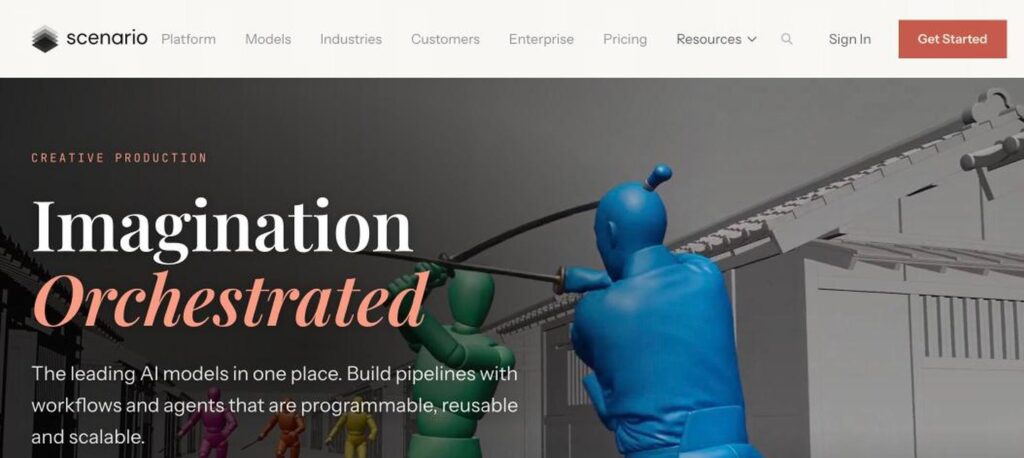
Scenario is an AI creative platform built for game studios and creators. It brings leading image, video and 3D models into one place and lets you train custom models on your own art, so every asset matches your game’s style. Plans start at $10 a month billed yearly, with a free trial.

What is Scenario?
Scenario started as an AI tool for generating game assets and has grown into a creative production platform. It gives you access to many leading AI models for images, video, 3D and audio in one workspace, and is used by game studios, publishers and indie developers.
Its main strength is consistency. You can train custom models on your own characters, items or art style, then generate new assets that look like they belong in the same game. Workflows and agents let teams build reusable, programmable pipelines, and an API lets you plug Scenario into your own tools and engines.
Scenario key features
Custom model training
Train models on your own art to keep every asset on-style.
Every AI model in one place
Use leading image, video and 3D generation models from one workspace.
Game asset generation
Create characters, props, icons, backgrounds and UI elements.
3D generation
Turn images into 3D models for prototyping and production.
Image editing tools
Upscale, remove backgrounds, retexture and edit with AI.
Workflows and agents
Build reusable, programmable pipelines for production.
Team workspaces
Collaborate with up to 25 users on the Max plan.
API access
Integrate Scenario into your tools, engines and pipelines.
Private generations
Keep your assets and models private.
Scenario pricing plans (2026)
Scenario has three self-serve plans and an Enterprise plan. Prices below are billed yearly, which saves 33% compared with monthly billing.
Starter
1,500 credits a month, access to every AI model, single user and 50 GB storage. Free trial available.
Pro
5,000 credits a month, priority queue, unlimited relaxed generations, custom model training and 500 GB storage.
Max
10,000 credits a month, workspace for up to 25 users, team tools and custom editing models.
Enterprise
For studios running AI at scale with security, support and custom terms.
Monthly billing: Starter $15, Pro $45 and Max $75. Check the latest prices on the official Scenario pricing page.
How to use Scenario
- 1
Go to scenario.com and start a free trial.
- 2
Pick an AI model or upload images of your art style.
- 3
Train a custom model to match your game’s look.
- 4
Generate characters, props, textures, 3D or video assets.
- 5
Edit, upscale and export assets into your game engine.
Who should use Scenario?
Game studios
Produce large sets of on-style assets faster.
Indie developers
Create art for games without a big art team.
Concept artists
Explore ideas and variations quickly.
Marketing teams
Make key art and promo visuals for games.
Pros and cons
What we like
- Custom models keep art style consistent
- Many top AI models in one place
- Built specifically for game workflows
- API and team workspaces available
Watch out for
- No permanent free plan
- Credits can run out fast with video and 3D
- Custom training needs the Pro plan
- Can be complex for beginners
Best Scenario alternatives
Scenario is one of the best AI tools for game art because it focuses on what studios need most: consistent, on-style assets. Custom model training, many models in one place and an API make it a strong choice for indie teams and larger studios alike.
Scenario FAQs
Is Scenario free?
Scenario offers a free trial, but its paid plans start at $10 a month billed yearly.
How much does Scenario cost?
Starter costs $10 a month, Pro $30 and Max $50 billed yearly, or $15, $45 and $75 monthly.
Can I train my own AI model on Scenario?
Yes. You can train custom models on your own art on the Pro plan and above.
Can Scenario make 3D models?
Yes. Scenario includes 3D generation models alongside image and video models.
Is Scenario good for game development?
Yes. It is built for game assets like characters, props, textures and UI.
Does Scenario have an API?
Yes. Scenario has an API to connect it to your own tools and pipelines.